ARTIST STATEMENT
Humans once looked at clouds and invented myths; machines look at clouds and invent labels.
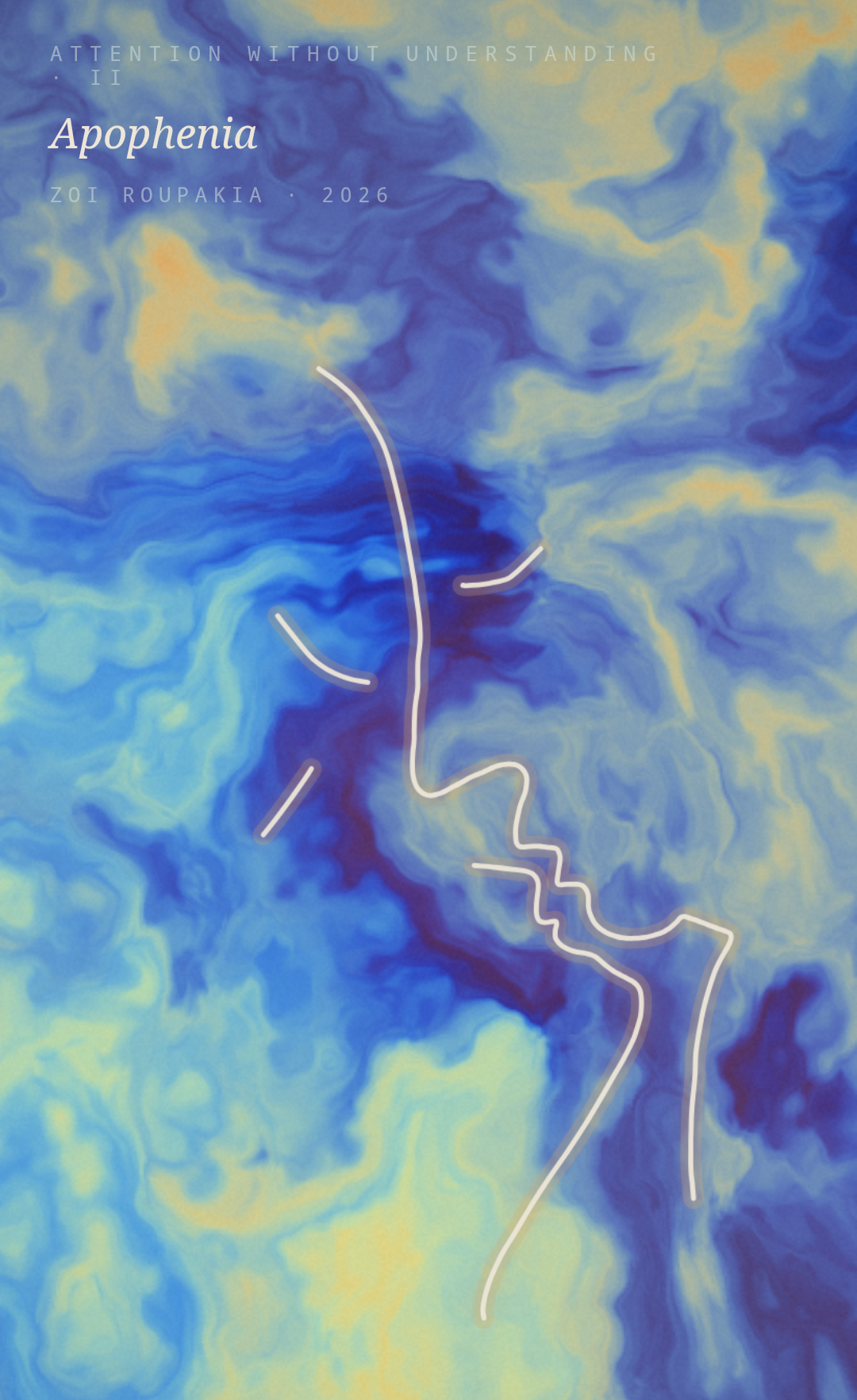
Apophenia is an interactive artwork that explores the tendency of both humans and machines to perceive meaning in ambiguity.
The title derives from the Greek words apo — away from — and phainein — to show or make visible — and refers to the psychological phenomenon of apophenia: the perception of patterns, connections or significance within random or unrelated stimuli. A visual form of apophenia, known as pareidolia, occurs when people recognise faces, animals or objects in clouds, shadows, rocks or other ambiguous forms. Looking for shapes in clouds is one of its most familiar examples.
The work presents a continuously evolving field of cloud-like forms generated through procedural computation. As the visual landscape changes, an AI vision model repeatedly scans small regions of the image and attempts to identify what it sees. Faces, animals, figures and objects emerge from statistical pattern matching, even when no such forms were intentionally created.
Visitors can also draw directly onto the surface of the work. The system interprets these marks using the same vision model, generating labels that reveal how machine perception transforms lines and shapes into categories and predictions.
Apophenia extends questions first explored in Attention Without Understanding, exhibited at the CVPR 2026 Art Gallery. That work examined how a vision transformer distributes attention across an image without accessing meaning. Apophenia moves from attention to interpretation. Rather than visualising where a model looks, it examines what happens when a model attempts to impose meaning onto ambiguity.
Humans and machines share a common impulse: both seek patterns. Yet the mechanisms differ. Human pareidolia is shaped by memory, culture, emotion and imagination. Machine perception is shaped by statistical correlations learned from training data. The resulting labels often feel convincing, but they remain acts of inference rather than understanding.
The work invites viewers to reflect on a broader question surrounding artificial intelligence: when a machine identifies a face, a bird or a figure, is it recognising something that exists, or merely projecting patterns onto uncertainty?
Full interactive work: https://apophenia-2026.netlify.app/
Technical Details
Apophenia is a browser-based interactive artwork created using JavaScript, WebGL/GLSL and machine-learning models executed directly on the viewer's device.
The visual field is generated procedurally in real time through layered, domain-warped fractal noise and shader-based rendering. Rather than using pre-existing imagery, the artwork continuously synthesises cloud-like formations that never repeat.
A CLIP-based vision-language model (ViT-B/32), run in-browser via Transformers.js, analyses selected regions of the generated image and attempts to classify perceived objects, figures and faces through zero-shot image classification. The same model is used to interpret visitor drawings. All inference takes place locally within the browser; no image data leaves the viewer’s device.
The artwork therefore combines three forms of perception:
Procedural generation of ambiguous visual stimuli.
Machine interpretation through computer vision.
Human interpretation through observation and imagination.
Every viewing experience is unique, yet all viewers encounter the same underlying question: how much meaning exists in the image, and how much is created by the observer?
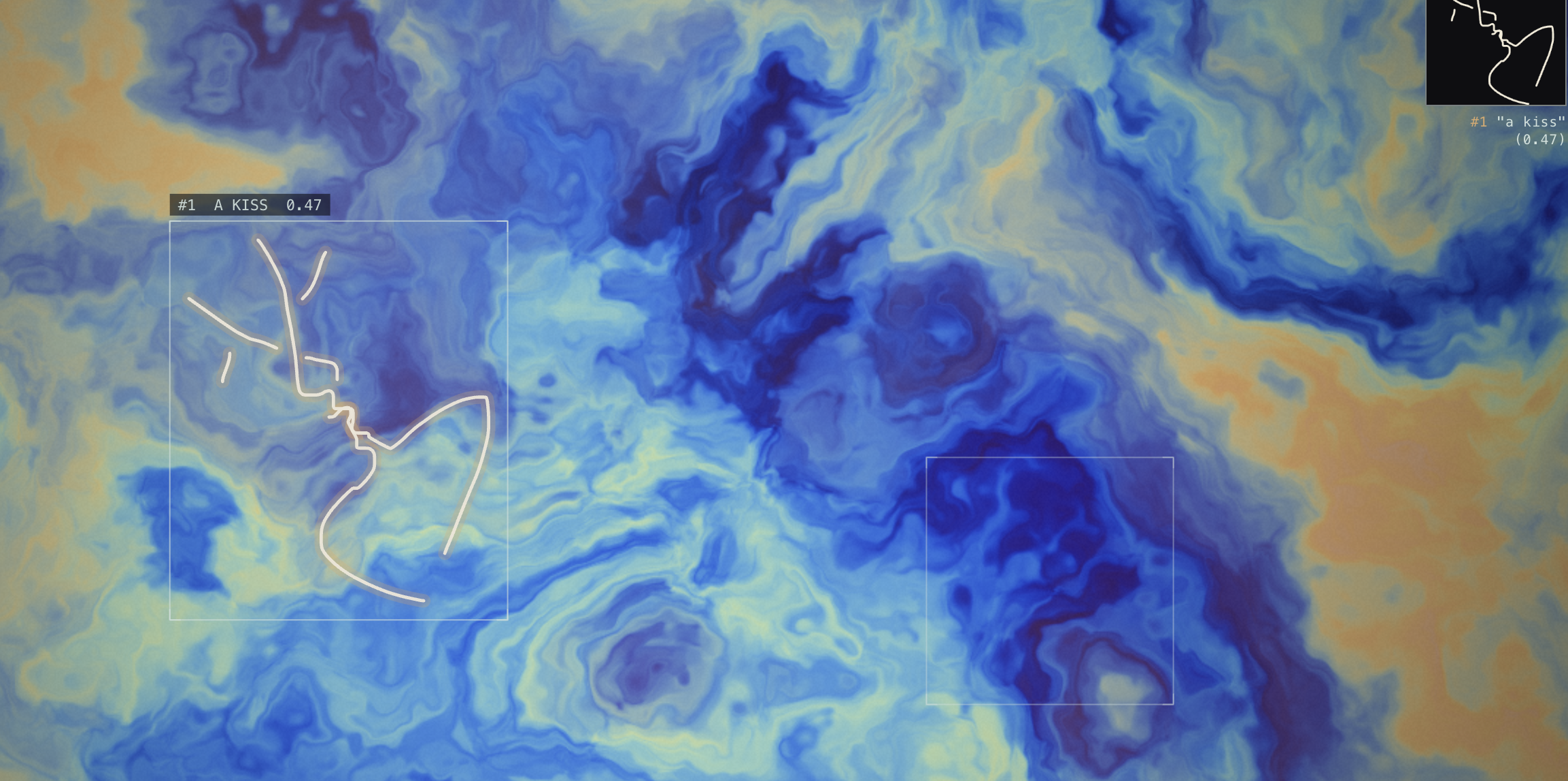
Apophenia (2026). A Kiss. Attention Without Understanding II. Zoi Roupakia